
Interview
Interview Preparation for Career Switchers: What to Focus On First
Switching into software engineering is one of the few career moves where the interview itself feels like a second job: algorithms, system design, behavioral ...
Switching into software engineering is one of the few career moves where the interview itself feels like a second job: algorithms, system design, behavioral stories, portfolios, take-home projects. For many career switchers, the real question isn’t “How do I prepare?” but “What should I focus on first so I don’t drown?”
This guide is a structured roadmap for career switch interview preparation—especially for tech career transitions into software roles. We’ll break down what matters most early on, what can wait, and how to build a preparation plan that compounds instead of scatters your effort.
1. Understand the Interview Landscape Before You Grind
Before touching LeetCode or rewriting your resume, you need a clear model of what software interviews actually test. Without this, “interview prep for beginners” often devolves into random problem-solving with minimal payoff.
1.1 The Four Core Dimensions of Software Interviews
Most software interviews for career switchers (especially junior or entry-level roles) evaluate four dimensions:
-
Foundational Coding Ability
- Writing correct, readable code in at least one language
- Understanding basic control flow, data structures, and debugging
-
Problem-Solving & DSA (Data Structures & Algorithms)
- Using patterns (e.g., sliding window, two pointers, BFS/DFS) to solve unseen problems
- Reasoning about time and space complexity
-
System & Practical Engineering Skills
- Building or understanding small systems: APIs, databases, simple services
- Version control (Git), testing, basic debugging strategies
-
Behavioral & Communication
- Explaining decisions clearly
- Demonstrating ownership, learning ability, and teamwork
- Translating prior (non-tech) experience into tech-relevant stories
For a tech career transition, your first focus should be: (1) foundational coding, then (2) pattern-based problem-solving. System design and deep architecture can come later.
1.2 How This Differs for Career Switchers
If you’re coming from another field (finance, academia, operations, design):
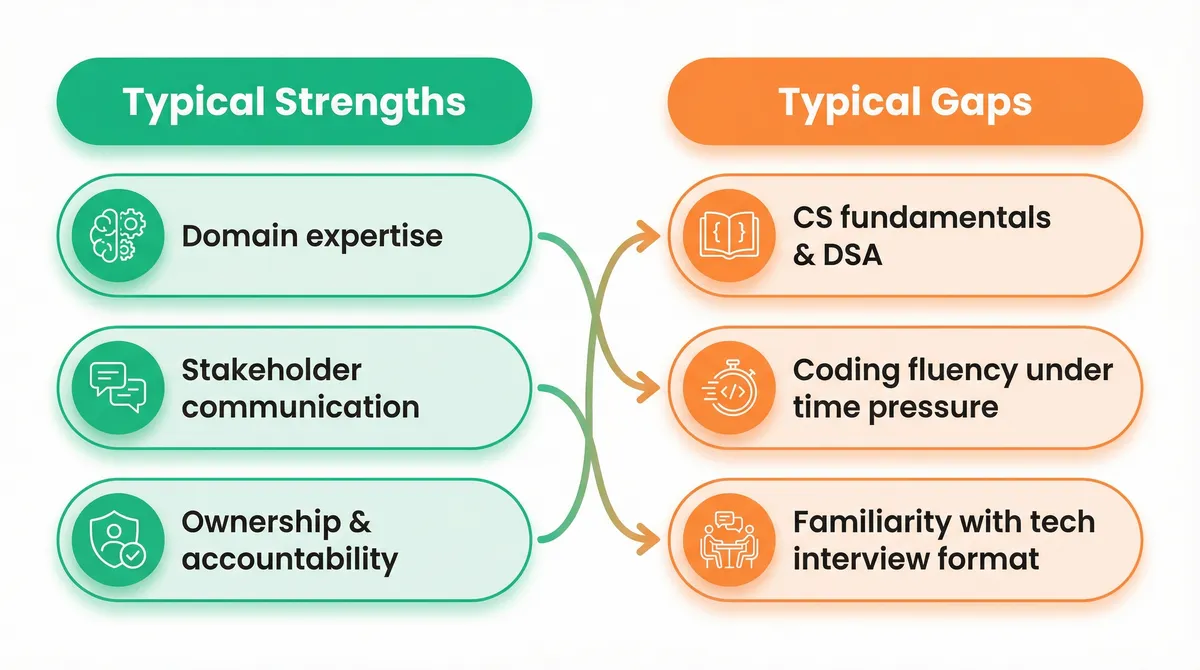
- You likely have strong domain knowledge and soft skills, but:
- You may lack depth in CS fundamentals and
- You may be less fluent in coding under time pressure.
Your main risk isn’t “not being smart enough”; it’s not being fluent enough in the specific patterns and expectations of software interviews.
So your first objective:
Get to “interview fluency” in coding and DSA, not research-level depth.
2. Choose a Language and Environment—and Stick to It
A common early mistake in career switch interview prep is bouncing between languages and tools. That slows fluency.
2.1 Criteria for Your Interview Language
Pick one primary language for interviews based on:
- Ecosystem & resources: Abundant tutorials, interview solutions, and community support
- Common choices: Python, Java, JavaScript/TypeScript, C++
- Readability under pressure: Short, expressive syntax helps in interviews
- Python and JavaScript often win here
- Target roles:
- Backend roles: Java, Python, Go, C# are common
- Frontend: JavaScript/TypeScript
If you’re a beginner or career switcher with no strong prior language:
Python is usually the most forgiving and expressive language for coding interviews.
2.2 Set Up a Minimal but Robust Dev Environment
Your environment should not be a source of friction. Set up:
- A code editor (VS Code, IntelliJ, PyCharm, etc.)
- Language runtime and package manager
- Git and a GitHub account
- A simple project structure:
interview-practice/arrays/linked-lists/graphs/- etc.
You don’t need a perfect setup; you need a repeatable one.
3. Build a Foundation: What to Learn Before Heavy DSA
Jumping straight into advanced dynamic programming as a beginner is like trying to run a marathon before you can jog a mile. For a successful tech career transition, ensure you have a stable base.
3.1 Core Programming Concepts (Non-Negotiable)
Before intensive algorithm practice, you should be comfortable with:
- Variables and types
- Conditionals (
if/else) - Loops (
for,while) - Functions (parameters, return values)
- Collections (arrays, lists, dictionaries/maps)
- Basic error handling
- Reading and writing from standard input/output
If you can’t implement a simple function like this without thinking too hard:
PYTHON
…then you’re not ready for serious DSA yet. Spend 1–3 weeks getting comfortable here.
3.2 Essential Data Structures for Beginners
For entry-level software interviews, you don’t need every data structure from a textbook. Focus on:
- Arrays / Lists
- Strings
- Hash Maps / Dictionaries
- Stacks and Queues
- Linked Lists (conceptually, even if not commonly used in production)
- Trees (especially Binary Trees, BSTs)
- Graphs (at least conceptually, with adjacency lists)
You should be able to answer:
- What is the typical time complexity of:
- Indexing into an array
- Looking up a key in a hash map
- Inserting into a stack or queue
- When would you choose one structure over another?
For a comprehensive overview of foundational data structures and interview preparation, consider following a beginner to advanced DSA roadmap for software engineers in 2026 to build your skills progressively.
4. Pattern-Based DSA: The Highest Leverage for Career Switchers
Random problem grinding is one of the least efficient ways to prepare for a career switch interview. What works better is pattern-based learning.
4.1 Why Patterns Matter More Than Individual Problems
Interviewers rarely care if you’ve seen a specific problem before. They care whether you can:
- Recognize the type of problem
- Map it to a known pattern
- Adapt that pattern to a new variation
Common examples:
- Sliding Window → Subarray/string problems with contiguous segments and constraints
- Two Pointers → Sorted arrays, linked lists, or in-place operations
- Fast & Slow Pointers → Cycle detection, middle of list
- Binary Search → Search in sorted arrays or monotonic answer spaces
- DFS/BFS → Tree/graph traversals, connected components
- Backtracking → Combinatorial search (subsets, permutations)
- Dynamic Programming → Optimization over subproblems (knapsack, LIS, etc.)
On platforms like Thita.ai, these are organized into DSA patterns across categories. You don’t need all 94 patterns to start; focus on the 10–15 most common.
4.2 A Beginner-Friendly Pattern Progression
For interview prep for beginners, a reasonable progression is:
- Arrays & Strings
- Two pointers
- Sliding window (fixed then variable size)
- Hashing
- Frequency counting
- Set-based existence checks
- Linked Lists
- Fast/slow pointers
- Trees
- DFS (preorder, inorder, postorder)
- BFS (level order)
- Binary Search
- On arrays
- On answer space
- Basic Recursion & Backtracking
- Introductory Dynamic Programming
- 1D DP (climbing stairs, house robber)
- 2D DP (grid paths, simple edit distance variants)
You can use a structured sheet like /dsa-patterns-sheet to track which patterns you’ve covered and which still need work.
To dive deeper into mastering these patterns, the The 90 DSA Patterns That Cover 99% of Coding Interviews is an excellent resource to understand and practice the most impactful coding interview patterns.
5. Example: From Brute Force to Pattern-Based Solution
To make this concrete, let’s walk through a classic array problem and show how a career switcher should think about it.
5.1 Problem: Longest Substring Without Repeating Characters
Given a string
s, find the length of the longest substring without repeating characters.
Brute Force Idea
- Generate all substrings
- For each, check if it has unique characters
- Track the maximum length
This works but is too slow.
- Generating all substrings: O(n²)
- Checking uniqueness per substring: O(n)
- Total: O(n³) time
Pattern-Based Solution: Sliding Window
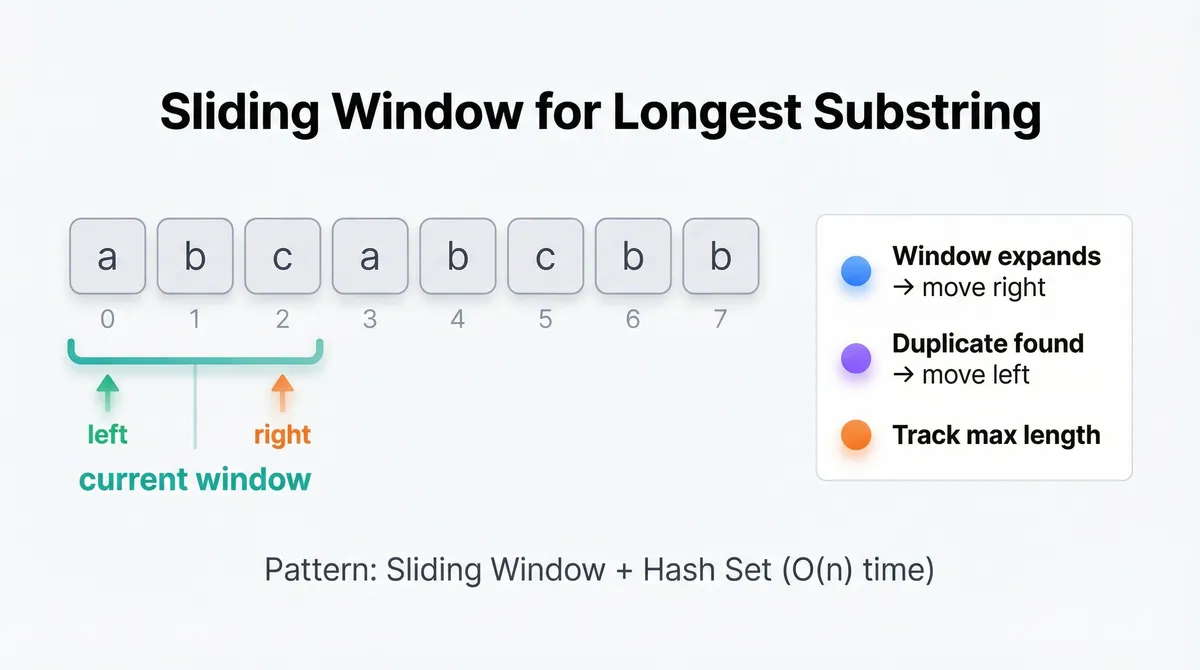
We want the longest contiguous substring with a constraint (no duplicates). This is a classic sliding window pattern.
Key idea:
Use two pointers (left, right) to represent a window and a hash map (or set) to track characters in the current window.
PYTHON
- Time complexity: O(n) — each character enters and leaves the window at most once
- Space complexity: O(min(n, k)), where k is the character set size
This is the type of transformation you want to practice:
From brute force → recognize pattern → implement pattern efficiently.
For more detailed guidance on mastering the sliding window and other essential patterns, check out the Master Sliding Window: 4 templates for Coding Interviews guide.
6. Practice Strategy: What to Do Week by Week
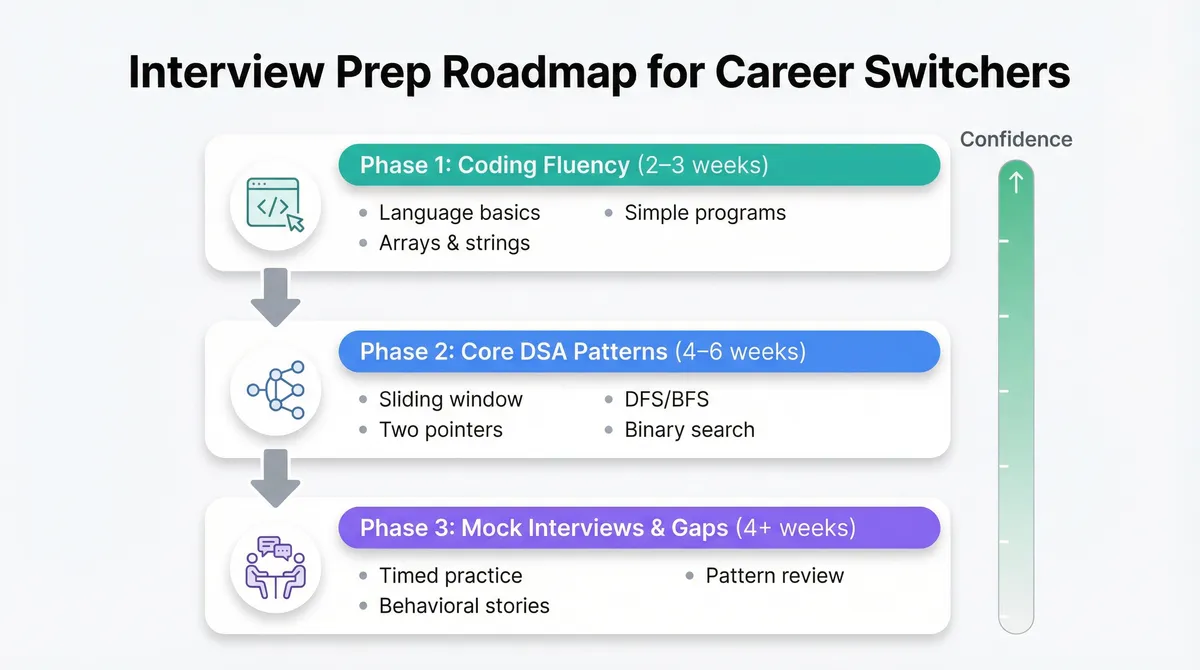
Instead of “do as many problems as possible,” structure your tech career transition around phases.
6.1 Phase 1 (2–3 Weeks): Coding Fluency & Basics
Focus:
- Write small programs daily (10–30 lines)
- Implement basic algorithms from scratch:
- Linear search
- Binary search (on a sorted array)
- Reverse an array
- String manipulation (e.g., reverse words, check palindrome)
Goals:
- You can write correct code without constant reference to documentation.
- You can run, debug, and fix simple logic errors.
6.2 Phase 2 (4–6 Weeks): Core Patterns & Repetition
Focus:
- Pick 1–2 patterns per week
- For each pattern:
- Watch/read 1–2 explanations
- Implement 3–5 problems of increasing difficulty
- Re-implement from memory after a few days
Example weekly structure:
- Mon–Tue: Sliding window (3 problems)
- Wed–Thu: Two pointers (3 problems)
- Fri: Review + re-implement solutions from memory
- Sat: Timed practice (simulate a 45–60 minute interview)
- Sun: Light review or rest
6.3 Phase 3 (4+ Weeks): Mock Interviews & Gaps
Focus:
- Start doing mock interviews (with peers, mentors, or tools like
/ai-interview) - Mix new problems with revisiting old patterns
- Track:
- Which patterns you struggle to recall
- Where you lose time (coding vs. thinking vs. debugging)
Goals:
- Reduce time-to-approach (how quickly you recognize the pattern)
- Improve verbal explanation while coding
- Build stamina for multiple rounds
To get the most out of your mock interview sessions, consider using AI-powered platforms as described in AI Tools for Interview Preparation: Benefits and Pitfalls, which can help simulate realistic interview environments and provide feedback.
7. Behavioral Interviews: Leverage Your Previous Career
Many career switchers over-index on LeetCode and under-index on behavioral interviews. That’s a mistake—especially because your non-tech background is your advantage, not your liability.
7.1 Map Your Past Experience to Engineering Signals
Companies look for signals like:
- Ownership
- Collaboration
- Dealing with ambiguity
- Learning new domains quickly
- Handling failures and feedback
From previous careers, you likely have:
- Projects you led or contributed to
- Conflicts you resolved
- Mistakes you made and fixed
- Processes you improved
Translate those into STAR-formatted stories:
- Situation: Context
- Task: Your responsibility
- Action: What you did
- Result: Outcome (with metrics if possible)
Example (from a non-tech role):
- Situation: Operations team missing SLAs due to manual workflows
- Task: Improve process efficiency
- Action: Analyzed workflow, automated parts with scripts, trained team
- Result: Reduced processing time by 40%, fewer errors, better on-time delivery
In a software interview, this shows:
- Problem-solving
- Initiative
- Ability to work with stakeholders
- Comfort with tools/automation (bonus for engineering roles)
7.2 Common Behavioral Questions for Career Switchers
Prepare for questions like:
- “Why are you switching to a tech career?”
- “Tell me about a time you had to learn something complex quickly.”
- “Describe a time you received critical feedback—what did you do?”
- “Tell me about a challenging project and your role in it.”
Write out bullet-point answers and practice saying them out loud. Tools like /ai-coach can help simulate follow-up questions and push for more depth.
8. Common Mistakes Career Switchers Make—and How to Avoid Them
8.1 Mistake: Grinding Hundreds of Random Problems
Symptom:
- You’ve solved 200+ problems but still freeze in interviews.
Why it happens:
- You’re memorizing specific solutions, not internalizing patterns.
- You’re not practicing under realistic constraints (time, explaining aloud).
Fix:
- Shift to pattern-based practice.
- Limit yourself to fewer problems per pattern, but re-implement them multiple times.
- Do regular timed sessions.
8.2 Mistake: Ignoring Fundamentals of the Chosen Language
Symptom:
- You know how to solve the problem conceptually, but:
- Forget syntax
- Struggle with off-by-one errors
- Misuse language features
Fix:
- Spend dedicated time on:
- Built-in data structures and methods
- Idiomatic loops and conditionals
- Common pitfalls (e.g., Python list vs. tuple, Java reference vs. value types)
- Implement utility functions from scratch:
- Custom
split,join,map,filter-style behavior
- Custom
8.3 Mistake: Over-Focusing on System Design Too Early
For junior roles and career switchers, most companies:
- Emphasize coding and problem-solving
- Only lightly touch system design, if at all
Fix:
- Defer deep system design study until:
- You are comfortable with core DSA patterns
- You’ve done several mock coding interviews
If you want to understand when and how to approach system design preparation, the article How AI Is Changing Technical Interviews in 2026 provides insights into the evolving role of system design in interviews.
8.4 Mistake: Underestimating Behavioral Rounds
Symptom:
- You ace the coding round but don’t progress.
- Feedback mentions “team fit” or “communication.”
Fix:
- Treat behavioral prep as a first-class citizen:
- Prepare 8–12 STAR stories
- Practice concise, structured answers
- Get feedback from peers or mock interview tools
9. Best Practices and Actionable Tips
To make your career switch interview prep sustainable and effective, follow these practices.
9.1 Use a Practice Log
Track:
- Date
- Problems solved (with patterns)
- Time spent
- Mistakes made
- What you learned
This converts practice from “hours logged” to “insights gained.”
9.2 Always Start with Clarifying Questions
In interviews:
- Restate the problem in your own words
- Ask about:
- Input constraints
- Edge cases
- Expected time/space complexity
This buys thinking time and shows professionalism.
9.3 Narrate Your Thought Process
Don’t silently code. Interviewers want to see:
- How you approach the problem
- What trade-offs you consider
- How you debug
A simple structure:
- “I’ll start with a brute force approach to ensure correctness.”
- “Then I’ll optimize using [pattern] to meet the constraints.”
- “Let me walk through an example to validate.”
9.4 Learn to Estimate Complexity Quickly
For each solution:
- Identify loops and nested loops
- Recognize common complexities:
- O(1), O(log n), O(n), O(n log n), O(n²)
- Be able to say:
- “This is O(n²) because of the nested loops over the array.”
Practicing this builds intuition and helps you justify design choices.
9.5 Incorporate Mock Interviews Early
Don’t wait until you feel “ready” for mock interviews. Use them to:
- Expose blind spots
- Desensitize yourself to pressure
- Practice communication
You can mix:
- Peer mock interviews
- Online platforms (e.g.,
/ai-interviewfor instant practice) - Occasional paid services if needed
For strategies on how to effectively use mock interviews for faster improvement, see Mock Interviews: How to Use Them Effectively for Faster Improvement.
10. Putting It All Together: A Minimal, High-Impact Plan
For a career switch interview prep timeline of ~3–4 months while working or studying:
-
Weeks 1–3: Language & Basics
- Choose a language and set up environment
- Complete a beginner-friendly course or tutorial
- Implement 10–20 small programs
-
Weeks 4–9: Core Patterns
- Cover 2–3 patterns per week
- Solve 5–10 problems per pattern
- Re-implement key problems from memory
-
Weeks 10–14: Integration & Mock Interviews
- 2–3 mock interviews per week
- Fill pattern gaps
- Prepare and refine behavioral stories
- Start applying to roles
-
Ongoing: Feedback Loop
- After each interview:
- Write down what went well
- Note what failed (pattern recall, syntax, communication)
- Adjust your next week’s focus accordingly
- After each interview:
Key Takeaways
- For a tech career transition, prioritize fluency over breadth: one language, core DSA patterns, and consistent practice.
- Use pattern-based learning instead of random problem grinding to make your interview prep efficient.
- Don’t neglect behavioral interviews—they’re where your previous career can become a real asset.
- Structure your preparation into phases: fundamentals → patterns → mocks, with a feedback loop after each step.
- Aim for steady, compounding improvement, not overnight mastery; interviews reward consistency and clarity more than cleverness.
With a focused plan and deliberate practice, a career switch interview stops being an opaque gatekeeper and becomes a solvable engineering problem—one you’re fully capable of debugging and optimizing.