
Interview
I Have an Interview Tomorrow: What to Actually Do Tonight
Interview tomorrow? Use this focused evening plan to rehearse, prepare logistics and sleep well. Skip last-minute cramming and arrive calm, clear and ready.
If you have an interview tomorrow, your job tonight is not to become a different candidate.
You are not going to learn dynamic programming, master system design, memorise twenty behavioural stories, rewrite your CV, research every person at the company and somehow get eight hours of sleep. Trying to do all of that is not preparation. It is panic wearing a productivity costume.
The highest-value version of interview tomorrow last minute preparation is simpler: rehearse what you already know, identify the one or two weak points most likely to matter, sort out tomorrow’s logistics, then sleep.
If you have not done one realistic out-loud rehearsal yet, make that the centrepiece of your evening. A live voice AI interview gives you the part static tip lists cannot: an interviewer who asks a question, waits for your answer and follows up on what you actually say.
Tonight is about reducing avoidable mistakes. You are not trying to achieve perfection by midnight. You are trying to arrive tomorrow able to think clearly, explain yourself and recover when something goes wrong.
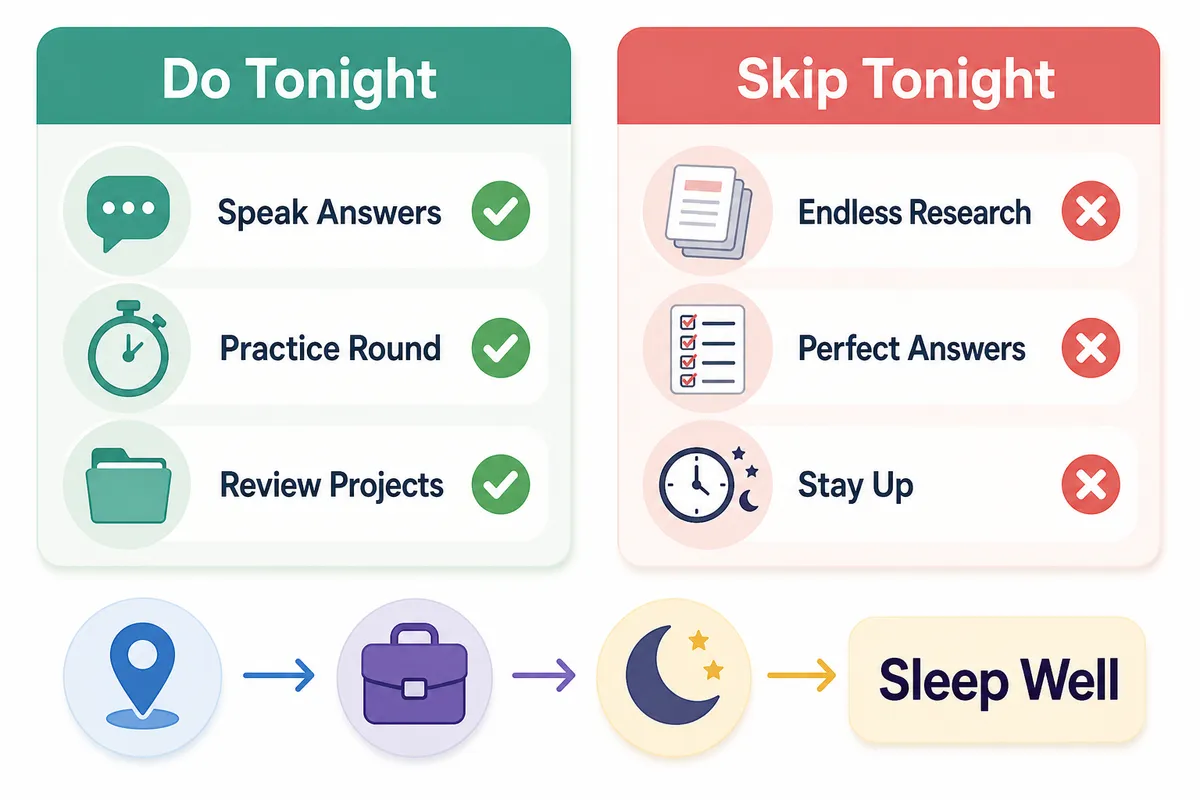
First: stop doing the things that feel productive but are mostly theatre
There is a difference between useful last minute interview preparation and activities that merely lower your anxiety for ten minutes.
Here is the honest version.
What genuinely helps tonight
- Saying your answers out loud rather than silently reading them
- Completing one timed, realistic practice round
- Reviewing your own past projects, decisions and measurable impact
- Revisiting familiar patterns, frameworks or concepts you have already used
- Checking the job description and matching your examples to it
- Preparing your environment, route, documents and equipment
- Sleeping enough to retrieve what you already know
What is mostly theatre tonight
- Starting an entirely new topic because it appeared in a forum post
- Watching five hours of interview videos at double speed
- Solving problems far above the likely difficulty because they look impressive
- Memorising polished scripts word for word
- Editing slides, a portfolio or your CV until 1:30am
- Reading dozens of company reviews and trying to predict every question
- Doing “just one more” coding problem after your concentration has gone
⚠️ Important: Cramming new material one day before interview is usually worse than rehearsing material you already understand. New information is fragile under pressure. Familiar knowledge, clearly explained, is what you can actually use tomorrow.
A candidate who explains one solid project well will generally make a stronger impression than a candidate who can vaguely name six advanced concepts they learned at 11pm.
The goal for tonight: make tomorrow feel familiar
Interview anxiety is partly uncertainty. You do not know what they will ask, how quickly they will ask it, whether you will get stuck or how you will sound when challenged.
You cannot remove all of that uncertainty tonight. But you can make the format less unfamiliar.
For a technical interview, that means hearing a problem, clarifying it, thinking aloud, writing a solution and responding when someone asks, “What happens with this edge case?”
For a behavioural interview, it means answering without reading notes, getting interrupted by a follow-up and giving a concrete example rather than drifting into generalities.
For product, data science, design or non-technical roles, it means structuring a response under time pressure, making assumptions explicit and defending your prioritisation.
That is why one live rehearsal matters more than another hour of passive revision. You are practising performance, not collecting information.
If you are interviewing from your CV, it is especially useful to do a resume-based mock interview from your own background. Questions based on your actual experience expose the gaps you are most likely to face tomorrow: a project you have not described clearly, a metric you cannot explain, or a decision whose trade-offs you have not considered in advance.
A concrete evening plan for the night before an interview
Adjust these times to your schedule, but protect the order. The live practice round comes before detailed revision because it tells you what actually needs attention.
6:30pm–6:45pm: Read the interview details once, then stop refreshing them
Confirm the basics:
- Interview time and time zone
- Interview format and expected duration
- Names and roles of interviewers, if provided
- Video link, office location or assessment platform
- Any stated requirements, such as a coding editor or portfolio
- The job description and the core skills it emphasises
Then write three short notes:
- What this role needs
- What I can already demonstrate
- What I need to explain more clearly
For example, if the role emphasises ownership, scalability and collaboration, identify one project story that demonstrates each. Do not prepare a different story for every imaginable competency. Reuse a small set of strong examples from different angles.
✅ Do: read the job description for language you can mirror naturally tomorrow.
❌ Don't: spend an hour researching the company’s entire history. Know the role, the product or team context and one sincere reason you are interested. That is enough for tonight.
6:45pm–7:15pm: Build your short answer sheet
Use one page only. If your notes become a document you need to scroll through, they are too long to help.
Write prompts, not scripts:
- “Tell me about yourself” — current role or background, relevant strengths, why this role now
- Two or three project stories with problem, action, result and learning
- One setback, disagreement or mistake story
- One reason you want this company or role
- Three questions to ask the interviewer
- For technical roles: your standard approach to clarifying, coding, testing and discussing complexity
For behavioural answers, use a simple structure: situation, task, action, result, reflection. The reflection is often the missing part. Interviewers do not only want to know what happened; they want to know what you learnt and what you would do differently.
If behavioural answers are your biggest concern, use this guide to resume-based mock interviews as a reminder to prepare clear, evidence-based examples rather than scripts to memorise overnight.
💡 Pro Tip: Your answer sheet should make you remember, not make you read. If you need full sentences, simplify the story until you can explain it in your own words.
7:15pm–8:00pm: Do one live practice round
This is the part to prioritise.
Do not just solve a question silently. Do one round that resembles tomorrow’s interview as closely as possible. Say your answers aloud. Use a timer. Let someone interrupt you or use a tool that can ask follow-ups.
A live AI interview practice session is useful here because it can adapt to your answer instead of sitting there as a static checklist. You can practise coding, system design, low-level design, machine coding, behavioural, product management, data science, AI and ML, CS fundamentals or a resume-based round.
For coding interviews, choose a problem in a pattern you already know. Tonight is not the night to prove you can solve the hardest graph problem on the internet. It is the night to rehearse a reliable process:
- Restate the problem.
- Ask clarifying questions.
- Talk through a straightforward approach.
- Improve it if needed.
- Write clean code.
- Run test cases.
- Explain complexity.
- Handle a follow-up calmly.
Thita’s coding interviews let you practise in six languages: Python, C++, Java, JavaScript, Go and C#. Use the language you expect to use tomorrow, not the language that looks most impressive.
For system design, use the same principle. Pick a familiar prompt, state assumptions, identify requirements, sketch the core components and explain trade-offs. You do not need to cram every database, queue or caching strategy. You need to show structured judgement.
For a non-technical interview, simulate the difficult question you are hoping they do not ask: a career change, an employment gap, a failed project, a conflict or a weak point in your experience. Practising the answer once makes it far less intimidating tomorrow.
8:00pm–8:20pm: Review the practice, not your entire life
After the round, write down only three things:
- One thing you did well
- One thing you need to tighten
- One sentence or transition you want to use tomorrow
Then do a short repair session. If you missed an edge case, revisit that type of edge case. If your explanation was messy, rehearse the opening two minutes again. If you froze on complexity, write down the complexity of two familiar approaches and explain why.
For help with the specific skill of narrating your approach, read how to think out loud in coding interviews. The essential point is simple: say what you are considering before you disappear into silent problem-solving.
8:20pm–9:00pm: Review familiar material, not new material
This is your revision window. Keep it narrow.
For a coding interview, review:
- Two or three patterns you have solved before
- Common edge cases: empty input, one item, duplicates, boundaries, large values
- Your language syntax for collections, sorting, loops and common operations
- The basic complexity of your go-to approaches
For a system design interview, review:
- Functional and non-functional requirements
- Capacity assumptions
- API and data model basics
- Trade-offs between consistency, latency, cost and reliability
- Your preferred structure for presenting a design
For behavioural interviews, review your stories and results. Check that you can give a real number where one exists: users affected, time saved, revenue improved, error rate reduced, deadline met or team size involved.
For product and data roles, revisit your response framework: clarify the goal, identify users, define success metrics, make assumptions, prioritise and discuss trade-offs.
✅ Do: refresh concepts you have encountered before.
❌ Don't: open a new 90-minute course, start a new design framework or attempt a topic you have never successfully used.
9:00pm–9:30pm: Prepare tomorrow’s logistics
Logistics are not glamorous, but they are high-return. A candidate who begins flustered by a broken link, low battery or missing notebook starts the interview at a disadvantage before the first question.
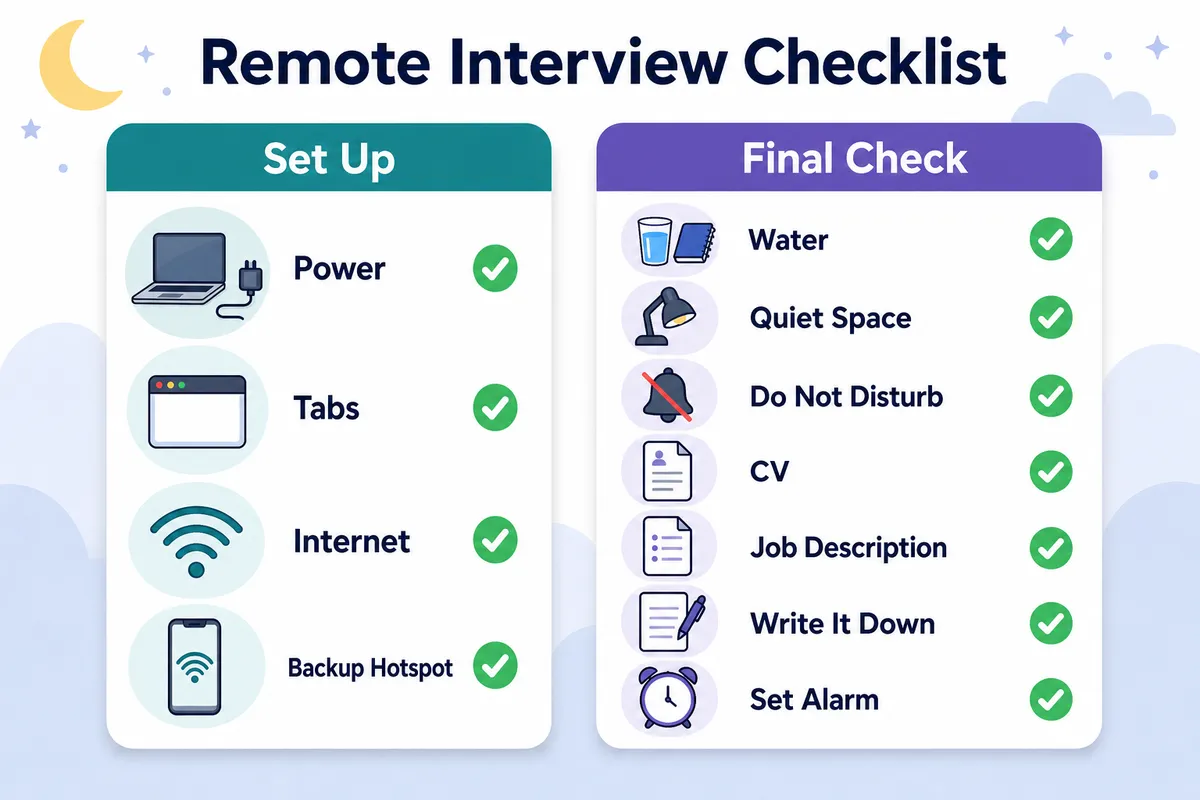
For a remote interview
- Test your camera, microphone and headphones
- Open the meeting link once
- Charge your laptop and keep the charger nearby
- Close unnecessary tabs and silence notifications
- Check your internet connection and prepare a backup hotspot if possible
- Put water, a notebook and a pen within reach
- Choose a quiet, well-lit place
- Tell people around you when you need not to be interrupted
- Keep your CV and the job description open or printed
For an in-person interview
- Confirm the address, route and expected travel time
- Add a realistic buffer for traffic or public transport delays
- Prepare clothes, shoes, ID and any required documents
- Pack your charger, notebook, pen and water
- Check whether you need visitor registration or building access
- Decide what time you will leave, not just what time you need to arrive
⚠️ Important: Do not rely on memory for tomorrow’s start time, link or address. Write it down in one place and set an alarm.
9:30pm onwards: wind down on purpose
There is a point where more preparation makes performance worse.
A tired candidate can know the correct answer and still struggle to retrieve it. They can make simple syntax errors, miss what the interviewer asked, talk too quickly, become defensive when challenged or lose track of a multi-step explanation.
Sleep is not a reward you earn after finishing every possible task. It is part of the preparation.
Try to stop serious interview work at least an hour before bed. Eat something normal. Drink water. Take a short walk, shower or do another low-stimulation routine. Avoid switching from frantic preparation to lying in bed scrolling through interview horror stories.
If your mind is racing, use a paper note:
- What is already prepared
- What I will do tomorrow morning
- What I cannot improve tonight
Then stop.
What to do tomorrow morning
Tomorrow morning is for activation, not cramming.
Give yourself enough time to eat, get ready and arrive without rushing. For a remote interview, be ready ten to fifteen minutes early. For an in-person interview, aim to be near the location early enough to absorb a minor delay without stress.
Use the final 15 minutes before the interview for a light reset:
- Read your one-page answer sheet
- Review the interviewer names, if you have them
- Say your introduction once out loud
- Read your questions for them
- Take a few slow breaths
- Drink water
- Put your phone away
Do not solve a difficult problem five minutes before the call. Do not search for “most asked questions” in a panic. Do not compare yourself with anonymous candidates online.
Your only job is to arrive present.
If you get stuck tomorrow, do this
Getting stuck is not automatically a failure. What matters is what you do next.
For technical questions:
- State what you understand.
- Say what you are considering.
- Test a small example.
- Ask a focused clarifying question if needed.
- Explain your next step before changing direction.
For behavioural questions:
- Pause for a few seconds.
- Choose a real example.
- Give context quickly.
- Spend most of the answer on your actions.
- Finish with the result and what you learnt.
For any question, avoid filling silence with vague talk. A short pause is better than a rambling answer. “Let me take a moment to organise my thoughts” is a completely reasonable thing to say.
Frequently asked questions
What should I do if my interview is tomorrow and I have not prepared enough?
Prioritise one realistic practice round, your strongest project stories, the job description and logistics. Do not try to cover everything. Rehearsing a small amount well is more useful than skimming a large amount badly.
Should I study the night before an interview?
Yes, but only familiar material. Review patterns, frameworks, project details and stories you already know. Avoid learning entirely new topics late at night, especially if it cuts into sleep.
What is the best last minute interview preparation activity?
One live practice interview is usually the highest-value activity because it exposes how you actually perform under pressure. It tests speaking, thinking, responding to follow-ups and recovering from mistakes.
Should I do a mock interview the night before?
Yes, if it is one focused round rather than a marathon. Finish early enough to review the main lesson, prepare logistics and wind down before bed.
What should I prepare for a behavioural interview tomorrow?
Prepare two or three strong examples involving impact, teamwork, conflict, setbacks, ownership and learning. Use prompts rather than memorised scripts so your answers still sound natural.
How late should I prepare the night before an interview?
Stop serious preparation at least an hour before bed. More late-night study often produces diminishing returns, while sleep improves attention, recall and emotional control.
Do one real rehearsal, then let yourself rest
If you are asking “interview tomorrow, what to do?”, the answer is not more tabs, more notes or more panic.
Do one live round. Rehearse the answers you are likely to give. Check your setup. Prepare your route. Sleep.
A live voice AI interview on Thita can give you that final realistic rehearsal across coding, system design, behavioural, product management, data science, AI and ML, or questions generated from your own CV. It is doing one session that helps tomorrow feel less new.
For a final technical refresher, you can also review common technical interview mistakes that reject strong candidates.
Then close the laptop. You have an interview tomorrow. Go in rested enough to show what you can already do.
Read next
- The Night-Before Interview Checklist, Plus a 20-Minute Mock Round — a more detailed logistics checklist and a focused final mock round.
Topics
Related on Thita
Your next step
Practise with AI mock interviews
A spoken interview that asks follow-up questions, runs your code and ends with a written report.