
Interview
What to Do the Night Before a Technical Interview
The night before a technical interview is deceptively important. You’ve spent weeks grinding LeetCode, reviewing system design, and refining your resume. But...
The night before a technical interview is deceptively important. You’ve spent weeks grinding LeetCode, reviewing system design, and refining your resume. But what you do in the final 12–24 hours can significantly affect how much of that preparation you can actually access under pressure.
This guide walks through a structured, engineering-style approach to the night before your interview: what to do, what not to do, and how to think about this time as “stabilizing the system” rather than “adding more features.” If you’re searching for “night before interview” advice or a concrete interview preparation checklist, this is designed to be both practical and technically grounded.
1. Mindset Shift: From Learning Mode to Execution Mode
You can’t meaningfully increase your knowledge the night before. You can dramatically improve your ability to access what you already know.
Think of it like deploying a service:
- The weeks before: building, testing, and iterating.
- The night before: validating configs, checking monitoring, reducing risk.
- Interview day: production traffic.
1.1 What Changes the Night Before
Switch from:
- “How much more can I learn?”
to - “How can I execute consistently under stress?”
Your goals the night before:
- Reduce cognitive load and decision fatigue.
- Prime key patterns and mental models.
- Stabilize sleep, nutrition, and logistics.
- Prepare a repeatable approach for each interview type (coding, system design, behavioral).
2. A Practical Interview Preparation Checklist for the Night Before
Here’s a concise checklist you can use as a reference.
2.1 High-Level Night-Before Checklist
-
Logistics
- Confirm interview time and time zone.
- Verify video platform, coding environment, and internet connection.
- Prepare your workspace (quiet, clean, power, backup devices).
- Lay out clothes, notebook, pen, and water.
-
Technical Warm-Up (60–90 minutes max)
- Light review of core DSA patterns.
- 1–2 easy/medium coding problems for rhythm, not learning.
- Quick system design outline drill (if relevant).
- Review your own past projects and resume bullets.
-
Behavioral and Communication
- Rehearse a structured self-introduction.
- Prepare 3–5 STAR stories (Situation, Task, Action, Result).
- Draft 3–5 thoughtful questions for the interviewer.
-
Mental and Physical Prep
- Plan sleep and wake times; set alarms.
- Prepare a simple meal plan (avoid extreme changes).
- Short walk/stretch; avoid intense late-night workouts.
- Decide your “first 5 minutes” routine for the morning.
-
Shutdown
- Stop all heavy prep 60–90 minutes before bed.
- Do something relaxing and offline.
- Avoid doom-scrolling interview forums.
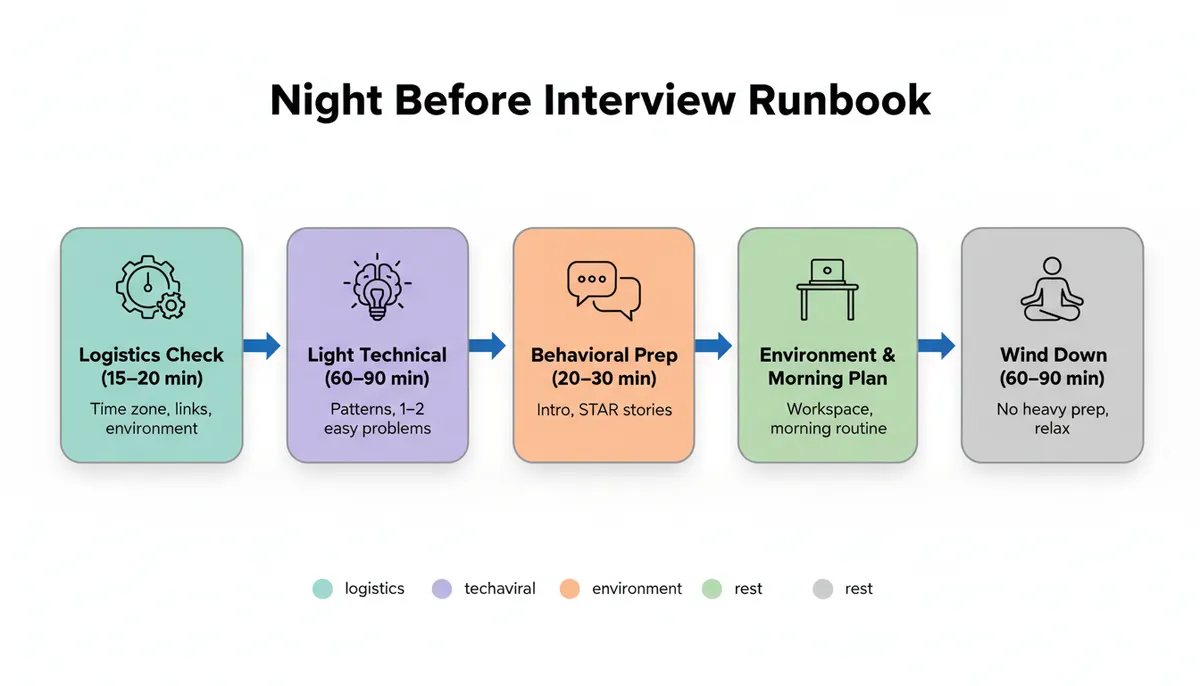
You can treat this as your “night before interview” runbook.
3. Technical Interview Tips: What to Review vs. What to Ignore
The biggest mistake candidates make the night before is trying to cram new concepts. That often increases anxiety and reduces sleep quality.
3.1 Focus on Patterns, Not New Problems
If you’ve been preparing using patterns (e.g., sliding window, two pointers, binary search, BFS/DFS, DP, etc.), your goal is to refresh those mental models, not discover new ones.
A pattern-based review might look like:
- Arrays & Strings
- Sliding window: fixed vs. variable window.
- Two pointers: opposite ends vs. fast/slow.
- Trees & Graphs
- DFS vs. BFS: recursion vs. queue.
- Typical use cases: shortest path, connected components, topological sort.
- Hashing
- When to use hash maps/sets to get O(1) lookup.
- Dynamic Programming
- Recognizing overlapping subproblems and optimal substructure.
- Tabulation vs. memoization.
If you’re using a structured pattern resource (e.g., a DSA patterns sheet like Thita’s What Are DSA Patterns? A Complete Guide for Beginners), this is the time to skim it, not deep-dive.
3.2 Example: Lightweight Pattern Review
Take the two pointers pattern. Instead of solving 5 new problems, do this:
- Write down: “Two pointers = maintain two indices to reduce search space, usually O(n).”
- List 2–3 problem archetypes from memory:
- Sorted array: find pair with target sum.
- Remove duplicates in-place.
- Reverse vowels in a string.
- Sketch the core loop once in pseudocode:
PYTHON
You’re not optimizing for breadth anymore; you’re optimizing for recall speed and pattern recognition.
4. How to Practice Coding the Night Before (Without Burning Out)
You can and should write some code the night before, but with strict constraints.
4.1 What Kind of Problems to Do
- Difficulty: Easy or lower-medium.
- Goal: Warm up your typing, syntax, and problem-solving flow.
- Timebox: 30–60 minutes total.
Suggested structure:
-
Problem 1 (easy array/string):
Focus on:- Reading carefully.
- Restating the problem out loud.
- Talking through a brute-force and then an optimized approach.
-
Problem 2 (easy tree/graph or hash map):
Focus on:- Choosing appropriate data structures.
- Writing clean, readable code with clear variable names.
- Doing a quick complexity analysis.
-
Optional Problem 3 (if you feel calm, not anxious):
Another easy problem in your weaker area.
4.2 Example Warm-Up Problem Walkthrough
Prompt (simplified):
“Given an array of integers nums and an integer k, return the number of contiguous subarrays whose sum equals k.”
You might outline:
- Brute force: O(n²) – enumerate all subarrays and sum.
- Optimized: use prefix sums + hash map to get O(n).
Code:
PYTHON
Explain to yourself:
- Time complexity: O(n) – single pass.
- Space complexity: O(n) – hash map storing prefix sums.
The point isn’t to learn this problem; it’s to rehearse the interview behavior: clarify, propose brute force, optimize, code, test, analyze.
5. System Design and Architecture: Light-Weight Night-Before Prep
If you have a system design or architecture round, the night before is about frameworks, not new architectures.
5.1 Rehearse a System Design Framework
Pick a consistent structure you’ll use for any design prompt. For example:
- Clarify requirements and constraints.
- Define APIs and high-level use cases.
- Estimate scale (QPS, data size, latency).
- Propose high-level architecture (clients, services, DBs, caches).
- Deep dive into 1–2 components.
- Discuss trade-offs and bottlenecks.
Spend 20–30 minutes doing:
- 1–2 quick outlines (no full design) for common prompts:
- “Design a URL shortener.”
- “Design a news feed.”
- Focus on:
- Saying your framework out loud.
- Drawing a quick box-and-arrow diagram.
- Naming 2–3 trade-offs per design.
You’re not trying to become a distributed systems expert overnight; you’re trying to ensure that under time pressure, you don’t forget to ask about requirements or non-functional constraints. For a deeper dive into system design preparation strategies, see How to Start System Design Preparation from Zero (Beginner Guide).
6. Behavioral Preparation: Don’t Neglect the “Soft” Side
Many candidates treat behavioral interviews as an afterthought. That’s a mistake, especially at senior levels.
6.1 Prepare a Clear Self-Introduction
You’ll almost certainly get some version of “Tell me about yourself.” Prepare a 60–90 second answer that:
- Briefly summarizes your background.
- Highlights 1–2 key projects or achievements.
- Connects your experience to the role you’re interviewing for.
Example structure:
- Current role and focus.
- Past experience (1–2 highlights).
- What you enjoy solving (types of problems).
- Why this role/company domain is interesting to you.
6.2 Prepare STAR Stories
Pick 3–5 stories that demonstrate:
- Conflict resolution
- Ownership
- Dealing with failure
- Leadership or mentoring
- Ambiguity and decision-making
For each, outline in a few bullet points:
- Situation: Context.
- Task: Your responsibility.
- Action: What you did.
- Result: Outcomes (ideally with metrics).
You don’t need to script them; you just need to have them top-of-mind. For more on behavioral interview strategies, check out Behavioral Interviews for Engineers: Real Questions and Strong Answers.
7. Environment and Logistics: Eliminate Preventable Failures
The easiest points to lose in an interview are often due to logistics, not algorithms.
7.1 Technical Environment Checklist
For remote interviews:
-
Internet
- Test your connection (speed and stability).
- Have a backup (mobile hotspot if possible).
-
Hardware
- Charge your laptop; keep it plugged in during the interview.
- Test microphone and camera.
- Use wired headphones if Bluetooth is unreliable.
-
Software
- Verify access to the coding platform (e.g., shared editor, HackerRank, internal tool).
- Disable aggressive notifications (Slack, email popups).
- Close irrelevant tabs and applications that might steal focus or CPU.
-
Workspace
- Quiet, neutral background.
- Good lighting (face clearly visible).
- Water bottle and notebook within reach.
For onsite interviews:
- Confirm address, building entry instructions, and ID requirements.
- Plan commute with buffer time; check traffic or transit conditions.
- Know where to park if driving.
8. Sleep, Nutrition, and Physiology: Engineering Your State
This isn’t wellness content for its own sake; it’s about maintaining cognitive performance.
8.1 Sleep Strategy
- Aim for 7–8 hours, but don’t panic if you sleep less.
- Avoid caffeine late in the day if it affects your sleep.
- Stop screens and heavy prep 60–90 minutes before bed.
- If your mind is racing, do a 5–10 minute brain dump on paper:
- List your worries.
- Write down your morning plan.
- Remind yourself that the heavy lifting is done.
Even if you don’t sleep perfectly, lying down in a dark, quiet room still helps recovery.
8.2 Food and Caffeine
- Eat something familiar; don’t experiment with new heavy foods.
- Avoid large sugar spikes right before the interview.
- If you drink coffee, stick to your usual amount and timing. Don’t suddenly double your intake.
9. Morning Runbook: Decide It the Night Before
A simple way to reduce anxiety is to decide exactly what you’ll do in the first 60–90 minutes after waking up.
Example morning routine:
- Wake up, drink water.
- Light breakfast (e.g., eggs/toast, oatmeal, yogurt).
- 5–10 minute walk or stretch.
- 20–30 minutes of light technical warm-up:
- Skim DSA patterns.
- One very easy coding problem.
- 5 minutes reviewing your self-introduction and STAR bullets.
- 10 minutes of quiet time (breathing, no screens) before the call.
Write this down the night before so you aren’t making decisions in a stressed state. For tips on how to revise efficiently, see How to Revise DSA Efficiently Before Interviews.
10. Common Mistakes the Night Before a Technical Interview
Here are patterns that consistently hurt performance.
10.1 Cramming New Topics
Examples:
- Trying to learn dynamic programming from scratch at 11 PM.
- Reading a 40-page system design doc you’ve never seen before.
- Attempting to memorize niche algorithms or trivia.
Impact:
- Increases anxiety.
- Decreases sleep quality.
- Rarely yields usable recall under interview pressure.
10.2 Doing Only Hard Problems
Grinding 3–4 hard problems the night before tends to:
- Damage confidence (you’re more likely to get stuck).
- Reinforce the feeling that you’re “not ready.”
- Lead to mental fatigue the next day.
10.3 Over-Scripting Answers
Memorizing exact sentences for behavioral answers often backfires:
- You sound robotic.
- If the question changes slightly, you freeze.
- You spend cognitive effort trying to recall the script instead of listening.
Instead, memorize structures and bullet points, not paragraphs.
10.4 Staying Up Too Late “Just to Do One More Problem”
This is equivalent to deploying untested code right before a major launch. The marginal gain from one more problem is usually far less than the cost of reduced sleep and increased stress.
11. Best Practices and Actionable Tips (Condensed)
Here’s a more tactical list of technical interview tips specifically for the night before:
11.1 For Coding Interviews
- Review 5–10 core patterns (sliding window, two pointers, BFS/DFS, binary search, DP, intervals, etc.).
- Solve 1–3 easy problems to warm up.
- Practice speaking your thought process out loud while coding.
- Rehearse a consistent approach:
- Clarify problem.
- Give examples.
- Propose brute force.
- Optimize.
- Code.
- Test with edge cases.
- Analyze complexity.
11.2 For System Design Interviews
- Rehearse your design framework.
- Sketch 1–2 high-level designs from memory (no deep dive).
- Review common components:
- Load balancers, caches, databases, queues.
- CAP theorem trade-offs at a high level.
- Prepare a mental checklist of non-functional requirements:
- Scalability, availability, latency, consistency.
11.3 For Behavioral Interviews
- Prepare your self-introduction.
- Outline 3–5 STAR stories.
- Reflect on:
- A time you failed and what you learned.
- A time you disagreed and how you handled it.
- A project you’re proud of and why.
12. Visualizing the Night-Before Flow
13. Example: Minimal Night-Before Plan You Can Copy
If you want something you can almost literally follow step-by-step:
T–12 to T–10 hours (afternoon/evening)
- Confirm time, links, and environment.
- Check internet, camera, microphone.
- Print or open your interview schedule if available.
T–6 to T–3 hours (early evening)
- 60–90 minutes:
- Skim DSA patterns.
- Solve 1–2 easy problems.
- Do 1 quick system design outline if needed.
- 20–30 minutes:
- Self-introduction.
- STAR stories.
T–3 to T–1 hours (pre-bed)
- Prepare clothes, notebook, pen, water.
- Write your morning routine on paper.
- Stop heavy prep.
- Light, relaxing activity (book, music, short walk).
Sleep window
- Aim for a consistent bedtime.
- Use a brain dump if you feel anxious.
14. Using Tools and AI the Right Way (Optional)
If you’re using AI tools to practice (e.g., mock interviews or an AI coach), the night before is not the time to introduce something completely new.
Good uses the night before:
- One short mock interview to rehearse your communication flow.
- Quick feedback on your self-introduction or resume bullets.
- Pattern review via structured prompts.
If you’ve already been using a tool like Thita’s Best Ways to Use AI for DSA and Coding Interview Preparation or How to Use AI Tools Like ChatGPT for Interview Preparation (Without Becoming Dependent), stick to the familiar flows that have helped you before. Avoid experimenting with new features late at night.
15. Key Takeaways
- The night before a technical interview is about stability and recall, not cramming.
- Focus on:
- Light pattern-based review.
- Easy warm-up problems.
- Clear frameworks for coding, system design, and behavioral questions.
- Eliminate preventable issues:
- Logistics, environment, and tools.
- Engineer your state:
- Reasonable sleep, familiar food, and a simple morning routine.
- Avoid:
- Hard problem marathons.
- New topics.
- Late-night panic prep.
Treat the night before like a production readiness review: verify, stabilize, and trust the work you’ve already done. The goal is not to be perfect, but to give yourself the best possible conditions to show what you already know.
Read next
- One Week to Prepare for an Interview: A Day-by-Day Plan — if your interview isn't tomorrow, this spreads the same preparation across a full seven-day plan.