
Interview
Top Reasons Candidates Get Rejected After the Final Technical Round
Most candidates assume that if they’ve reached the final technical round, the hard part is over. Then the email arrives: *“We’ve decided not to move forward.”*
Most candidates assume that if they’ve reached the final technical round, the hard part is over. Then the email arrives: “We’ve decided not to move forward.”
If you’re searching for “final round interview rejection” after a promising onsite or virtual loop, you’re not alone. Many strong engineers get rejected after clearing the hardest data structures and algorithms rounds. Understanding why this happens is the first step to fixing it.
This post breaks down the most common technical interview rejection reasons in the final round—especially for software engineer interviews—and turns them into concrete, fixable behaviors. We’ll focus on what experienced interviewers actually look for beyond coding, and how to avoid subtle interview mistakes that cost offers at the last mile.
What Makes the Final Technical Round Different?
Earlier rounds mostly answer: “Can this person code and reason about problems at our bar?”
Final rounds (onsites, hiring manager rounds, virtual loops) answer a different question:
“Do we want to work with this person for the next several years?”
That leads to a different evaluation axis:
- Technical depth over breadth
- System design and tradeoffs
- Communication clarity and collaboration
- Ownership, judgment, and decision-making
- Culture and team fit (in a professional, not personal, sense)
- Signal consistency across all interviewers
This shift is why you can “do fine” in coding rounds and still face final round interview rejection. Let’s break down the main reasons.
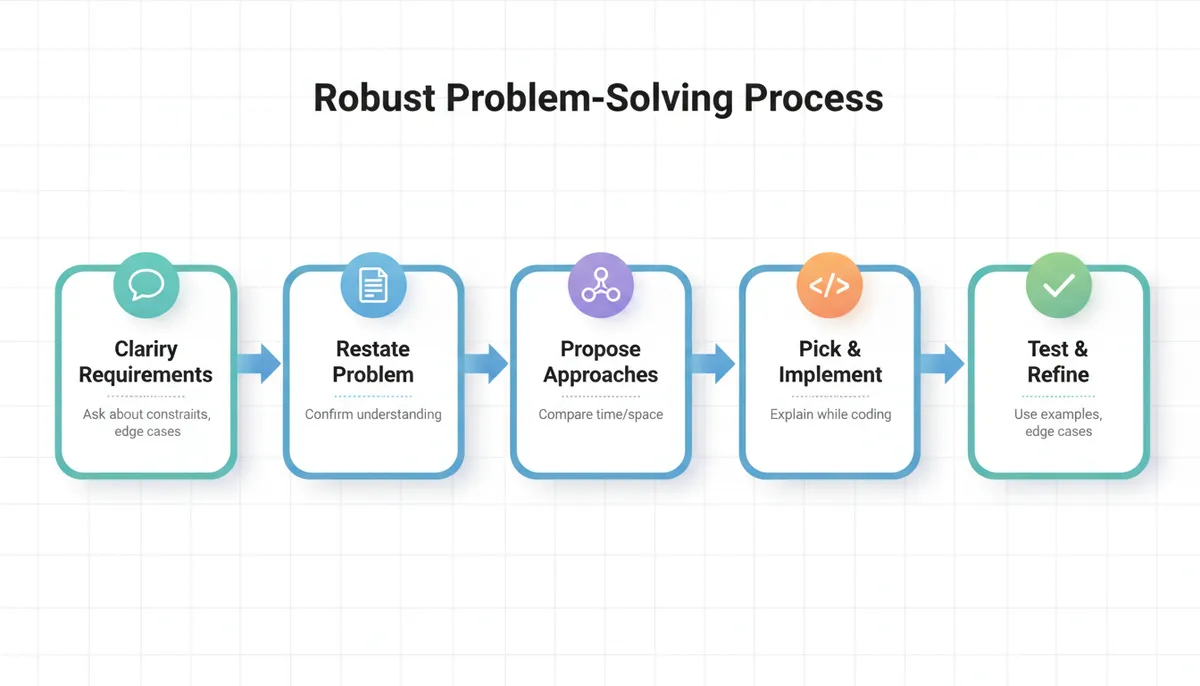
1. Weak Problem-Solving Process (Even When the Code Works)
Many candidates think the goal is: “Write a working solution as fast as possible.”
In final technical rounds, the real goal is: “Demonstrate a repeatable, robust problem-solving process we can trust on real, ambiguous work.”
1.1 Jumping to Code Without Clarifying Requirements
Common failure pattern:
- Hear the problem
- Assume you know what they mean
- Start writing code immediately
Interviewers see this as:
- High risk of misalignment on real tasks
- Poor communication habits
- Lack of product awareness
Instead, strong candidates:
- Rephrase the problem in their own words
- Ask clarifying questions:
- “What are the expected input sizes?”
- “How should we handle invalid data?”
- “Is order important in the output?”
- Explicitly confirm constraints and edge cases
This doesn’t just “look good”—it prevents you from solving the wrong problem.
1.2 Not Exploring Multiple Approaches
Another technical interview rejection reason: giving the first solution that comes to mind and sticking to it.
Interviewers want to see:
- Baseline solution (even if brute force)
- At least one improved approach
- A quick comparison of tradeoffs
Example (array problem):
- Baseline: O(n²) nested loops
- Optimized: O(n) with a hash map
- Tradeoff: time vs. space complexity
Even if you end up coding the baseline (due to time), explicitly walking through alternatives shows senior-level thinking and aligns with best practices in how to practice coding interview questions effectively.
1.3 Silent Coding and Opaque Thinking
In early rounds you might get away with “heads-down coding.” In final rounds, silence is a red flag:
- Interviewers can’t see your reasoning
- They can’t help unblock you
- They can’t evaluate collaboration
Instead, narrate your thinking:
PYTHON
Even for simple problems, explicitly stating your plan and complexity is part of what’s being evaluated. This approach is emphasized in many best ways to use AI for DSA and coding interview preparation guides.
2. Final Round Interview Rejection Due to System Design Gaps
For mid-level and senior software engineer interviews, system design is a major filter in the final round.
2.1 Designing “Toy” Systems
A common issue: designing something that would work for a coding bootcamp project, not a production system.
Symptoms:
- No mention of scale or traffic patterns
- No data model discussion
- No consideration of failure modes
- Everything fits in a single service
Interviewers need to see you can think in terms of:
- Scale: “What happens at 10x traffic?”
- Reliability: “What if this dependency is slow or down?”
- Consistency: “Can users see stale data? Is that acceptable?”
- Latency: “Where are the bottlenecks?”
2.2 No Structured Approach
Strong system design answers usually follow a predictable structure:
- Clarify requirements (functional + non-functional)
- Define APIs and core use cases
- Sketch a high-level architecture
- Dive into key components (storage, caching, queues)
- Address bottlenecks, failures, and tradeoffs
- Summarize and check if requirements are met
When candidates skip steps or randomly jump around the diagram, interviewers lose confidence in their ability to lead real design discussions. For a detailed guide, see step-by-step framework to answer any system design interview question.
2.3 Over-Indexing on Buzzwords
Another common interview mistake: dropping terms like “Kafka,” “CQRS,” “event sourcing,” “microservices,” without:
- Explaining why they’re needed
- Describing tradeoffs
- Connecting them to actual requirements
Interviewers care less about specific tools and more about reasoning:
- Why would you choose a message queue here?
- When would you prefer eventual consistency?
- Why a document store vs. relational DB?
If you’re unsure, say so, then reason from first principles. That’s better than misusing jargon.
3. Communication and Collaboration Issues
By the final round, the question shifts to: “Would I put this person on my team?”
Technical skill alone is not enough if communication issues suggest future friction.
3.1 Poor Listening and Interruptions
Red flags interviewers notice:
- Interrupting questions mid-sentence
- Answering a different question than the one asked
- Ignoring hints or guidance
This signals:
- Difficulty working in cross-functional teams
- Potential conflict in code reviews
- Low openness to feedback
Practice active listening:
- Let the interviewer finish
- Pause for a beat
- Paraphrase: “So you’re asking whether…”
- Then answer
3.2 Overly Defensive or Argumentative
Healthy disagreement is good; defensiveness isn’t.
Problem patterns:
- Arguing aggressively when corrected
- Refusing to consider alternative designs
- Blaming unclear questions instead of asking for clarity
In a final loop, this can easily tip a “lean yes” to a “no hire.”
Better pattern:
- “That’s a good point. I hadn’t considered X.”
- “We could also do it your way; the tradeoff I see is Y.”
- “Given these constraints, I’d lean toward option A, but B could work too.”
3.3 Under-Communicating Tradeoffs
Senior engineers are expected to articulate tradeoffs clearly.
Weak answer:
“I’d use a cache to make it faster.”
Strong answer:
“I’d add a Redis cache between the app and the DB.
Reads go to cache first; on miss we hit the DB and populate the cache.
Tradeoffs:
- Better read latency and lower DB load
- Risk of stale data; we’ll need an eviction strategy and cache invalidation on writes.”
The difference is not the idea, but the clarity and awareness of implications.
4. Behavioral and “Fit” Concerns in Technical Interviews
Many final round interview rejections are not about code at all. Behavioral rounds (or behavioral questions embedded in technical interviews) assess:
- Ownership
- Collaboration
- Learning mindset
- Handling ambiguity and failure
4.1 Shallow or Vague Stories
Common issue: answering behavioral questions with generic, buzzword-heavy responses.
Question: “Tell me about a time you disagreed with a teammate.”
Weak answer:
“We had different opinions, but we worked together and delivered on time.”
Strong answer structure (STAR: Situation, Task, Action, Result):
- Situation: “We were migrating a monolith to services; I owned the payments domain.”
- Task: “A teammate proposed splitting payments into 5 microservices; I was concerned about operational complexity.”
- Action: “I gathered incident data, modeled call graphs, and proposed an alternative: 2 services with clear boundaries. We did a design review with the team.”
- Result: “We reduced deployment blast radius by 60% vs monolith, while keeping latency under 150ms p95. The team later used the same pattern for other domains.”
Vague stories make it hard for interviewers to see your actual impact and behavior. For more on structuring behavioral answers, see behavioral interviews for engineers: real questions and strong answers.
4.2 Signaling Low Ownership
Red flags:
- Blaming “management” or “other teams” for all failures
- Never using “I” when describing contributions (only “we”)
- Showing no examples of taking initiative beyond assigned tasks
Interviewers look for:
- Times you went beyond your job description
- How you handle incomplete specs
- Whether you proactively fix issues or just file tickets
4.3 Misalignment With Role Level
Sometimes you’re rejected not because you’re “bad,” but because your demonstrated level doesn’t match the role:
- Applying for Senior, but stories show only task execution, not leadership
- Applying for Staff, but no evidence of cross-team impact or strategy
- Applying for Mid-level, but needing heavy guidance in problem-solving
This is still a rejection, but the underlying reason is level mismatch, not raw ability.
5. Inconsistent Signal Across Interviewers
In many companies, final hiring decisions are made in a debrief or hiring committee where all interviewers compare notes.
Common rejection pattern:
- One interviewer: strong yes
- One: weak yes
- One: no
- One: strong no
If the signal is inconsistent, committees tend to err on the side of “no hire.”
5.1 Spiky Performance
You might:
- Crush the algorithm round
- Do okay in system design
- Struggle badly in behavioral
- Or vice versa
This inconsistency raises questions:
- Are we seeing the candidate’s true baseline?
- Will they be reliable across the breadth of the role?
The solution is not to over-optimize one area (e.g., LeetCode) while neglecting others (e.g., communication, behavioral, systems). For insights on balancing preparation, see 7-day, 30-day, and 90-day coding interview preparation plans compared.
5.2 Mixed Feedback on Collaboration
One interviewer might find you easy to work with; another might report friction (interruptions, defensiveness, lack of listening).
In debrief, that’s often enough to block an offer, especially for collaborative teams.
6. Subtle Technical Interview Mistakes That Matter More in Final Rounds
Some small mistakes are forgivable in earlier rounds but become deciding factors at the end.
6.1 Not Testing Your Own Code
Even if the interviewer doesn’t explicitly ask for tests, failing to manually walk through your code is a negative signal.
Better pattern:
- Run through:
- A normal case
- A boundary case
- An edge case (empty input, duplicates, large values)
- Say out loud:
- “For input X, we do Y, then Z, and return W.”
This shows carefulness and real-world engineering habits.
6.2 Over-Optimizing Prematurely
Spending too long shaving constants or micro-optimizing before you even have a correct solution can hurt you.
Instead:
- Get a correct baseline
- Verify it
- Optimize if time allows and if complexity is truly an issue
Strong candidates explicitly say:
“I’ll start with a simple O(n²) solution to ensure correctness. If we have time, I’ll optimize to O(n log n) using sorting.”
6.3 Ignoring Constraints and Practicality
Red flags:
- Proposing in-memory solutions when data clearly doesn’t fit in memory
- Ignoring latency or throughput requirements
- Suggesting tech that doesn’t fit the problem domain
Interviewers want to see you think like a production engineer, not just an algorithm competitor.
7. How Interviewers Actually Decide: A Simple Mental Model
Most interviewers are implicitly asking:
“If I put this person on a real project with real constraints and stakeholders, will they:
- Solve the right problems?
- Build solutions that scale and don’t fall apart?
- Communicate clearly and collaborate well?
- Raise the bar for the team at their level?”
You can think of the decision as a simple evaluation across four axes:
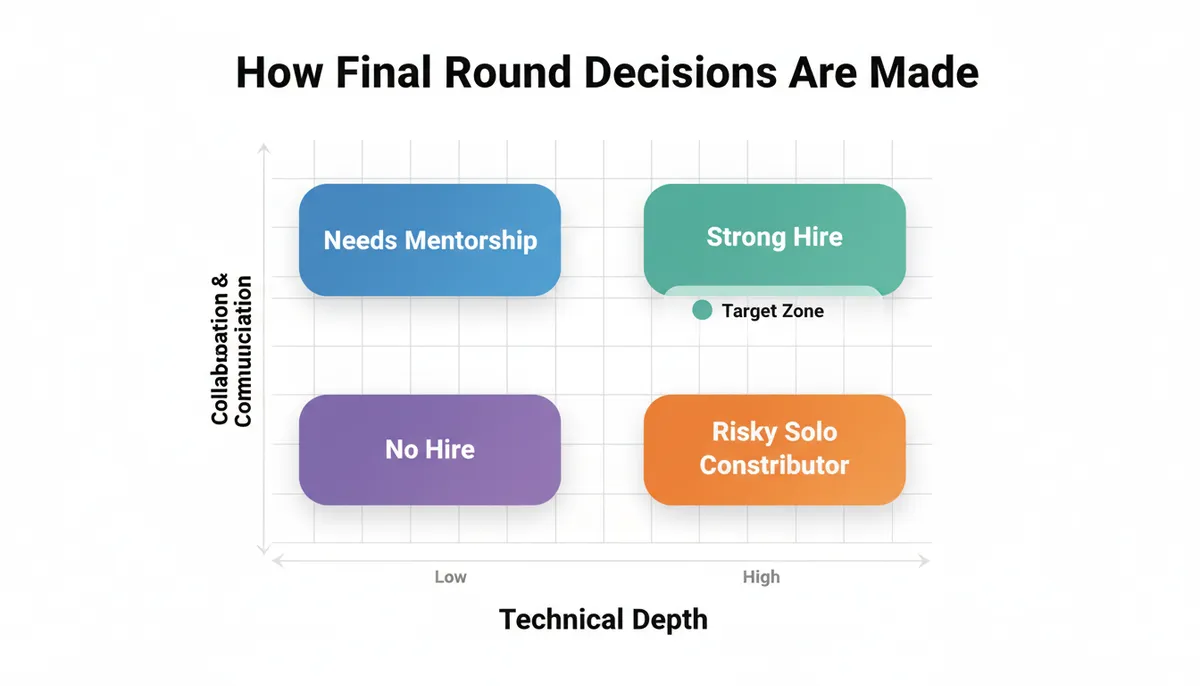
Your goal in the final round is not to be perfect, but to clearly land in the “Strong Hire” zone on enough axes that the committee feels confident.
8. Best Practices to Avoid Final Round Interview Rejection
Turning this into a checklist makes it easier to practice and self-evaluate.
8.1 For Coding Rounds
- Clarify first
- Restate the problem
- Ask about constraints, edge cases, input sizes
- Propose approaches
- Baseline + optimized
- Quickly compare time/space
- Think aloud
- Narrate data structures, invariants, and control flow
- Test your code
- Normal, boundary, and edge cases
- Reflect
- If time: discuss further optimizations or tradeoffs
8.2 For System Design Rounds
- Start with requirements
- Functional: core user actions
- Non-functional: scale, latency, consistency, availability
- Define APIs and data model
- Sketch main entities and relationships
- Draw a high-level architecture
- Clients, services, databases, caches, queues
- Dive into 1–2 key components
- E.g., write path, read path, or hot path
- Discuss tradeoffs
- Consistency vs availability
- Latency vs cost
- Simplicity vs flexibility
- Consider failures
- Timeouts, retries, degraded modes
8.3 For Behavioral and Cross-Functional Rounds
- Prepare stories using STAR
- Situation, Task, Action, Result
- Cover common themes
- Conflict, failure, ownership, ambiguity, learning, leadership
- Be specific
- Use numbers, scope, and concrete outcomes
- Show growth
- What you’d do differently now
- Stay professional
- Avoid blaming; focus on what you did
8.4 Practice Under Realistic Conditions
Reading about interview mistakes is helpful; practicing under pressure is better.
- Do mock interviews with peers or mentors
- Time-box coding problems and force yourself to narrate
- Practice whiteboarding or drawing system diagrams on paper or tablet
- Record yourself answering behavioral questions and critique clarity and structure
If you want structured, pattern-based practice for data structures and algorithms, a curated DSA for beginners: what to study first and in what order guide can help you avoid solving random problems and instead focus on reusable approaches.
9. Example: Turning a Weak Answer into a Strong One
To make this concrete, let’s take a typical system design prompt:
“Design a URL shortener (like bit.ly).”
9.1 Weak Final-Round Answer
- “I’ll use a web server and a database.”
- Draws a single box labeled “Server” and one “DB”
- Mentions hashing the URL but doesn’t discuss:
- Collisions
- Read/write patterns
- Scale or latency
- Data model
- Caching or replication
Interviewers see: Can code, but not ready to own production systems.
9.2 Stronger Final-Round Answer (Outline)
- Clarify requirements:
- Functional: create short URL, redirect, basic analytics
- Non-functional: millions of URLs, low-latency redirects, high availability
- APIs:
POST /shorten→ returns short URLGET /{shortId}→ redirect
- Data model:
url_mapping(id, long_url, created_at, owner_id, click_count, ...)
- High-level design:
- Load balancer → App servers → DB
- Cache (e.g., Redis) for hot URLs
- ID generation:
- Base62 encoding of numeric ID
- Or hash + collision resolution strategy
- Scale considerations:
- Read-heavy workload → aggressive caching
- DB sharding by ID range if needed
- Failures:
- Cache misses and DB failover
- Degraded mode if analytics store is down
You don’t have to cover everything perfectly, but a structured, tradeoff-aware approach is what separates offers from rejections.
10. Common Myths About Final Round Interview Rejection
Myth 1: “If I’m rejected, I must be bad at coding.”
Reality: Many rejections are about fit, level, or consistency, not raw coding ability.
Myth 2: “I just had a bad interviewer.”
Reality: One interviewer can be off, but most companies average across multiple signals. If you’re repeatedly rejected at the final round, there’s a pattern worth addressing.
Myth 3: “More LeetCode will fix everything.”
Reality: DSA practice helps, but final rounds heavily weigh system design, communication, and behavior. You need a balanced preparation strategy.
Key Takeaways
- Final rounds answer: “Do we want to work with you?”, not just “Can you code?”
- Common technical interview rejection reasons include:
- Weak problem-solving process (no clarification, no alternatives, silent coding)
- Shallow or unstructured system design
- Communication breakdowns and defensiveness
- Vague behavioral stories and low ownership
- Inconsistent performance across rounds
- Avoid subtle interview mistakes:
- Always clarify requirements
- Think aloud and test your code
- Structure system designs and discuss tradeoffs
- Use specific, impact-focused stories for behavioral questions
- Practice under realistic conditions and focus on process, not just outcomes.
Improving at final rounds is less about memorizing more tricks and more about thinking—and communicating—like the engineer you’ll be on the job. If you treat every interview as a chance to refine your problem-solving and collaboration habits, rejections become feedback loops, not dead ends.